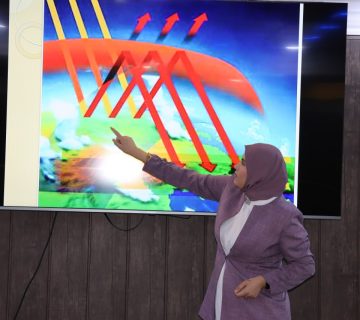


A PhD thesis was discussed at the Institute of Laser for Postgraduate Studies, which dealt with achieving a free spectral range (FSR) multi-wavelength, switchable, and tunable in an Erbium-doped fiber laser (EDFL). Two Mach-Zehnder interference filters (MZIs) were integrated from nonlinear photonic crystal fibers (NLPCF) connected in parallel within the ring design of the Erbium-doped fiber laser (EDFL) for the student Ali Salah Mahdi. The thesis also discussed producing a laser output with shorter wavelengths in the visible spectrum. A visible laser system was designed from a fiber optic doped with Pr3+/Yb3+ and using the energy gain technique for the first time in the world. The title of the thesis is “Near Infrared Towards Visible (Pr³+Yb³+) Wavelength Fiber Laser Generation” under the supervision of Prof. Dr. Abd Alhadi Mutashar Abd (first supervisor) and Assist. Prof. Dr. Sara Kadhim Mohsen (second supervisor).
This study aims to highlight the importance of laser applications in the visible and near-infrared spectrum, and its objectives are centered around four main aspects. It begins with the fabrication and testing of a Mach-Zehnder interferometer (MZI) filter based on advanced technology for welding nonlinear photonic crystal fibers with core-offset from one or both sides. This is followed by practical application through integrating these filters within an Erbium-doped fiber laser to generate multi-wavelength laser beams, with enhanced control over these wavelengths using polarization controllers that allow for wavelength switching and precise adjustment of the spacing between modes. The study concludes with a comprehensive theoretical and practical analysis of visible light laser generation through the up-conversion process in ZBLAN fibers doped with Pr3+ and Yb3+ ions, combining structural innovation with precise control and analysis.
The work focuses on developing and improving the performance of Erbium-doped fiber lasers (EDFL) to operate as multi-wavelength and tunable laser systems. This is achieved by inventing MZI filters based on NLPCF and advanced welding techniques (core-offset), allowing for control over wavelength spacing, switching, and reducing mode competition to ensure stability. The other aspect of the work focuses on mathematical modeling and design for visible light lasers using ZBLAN fibers, where simulations were conducted to optimize output power and pumping efficiency, with attempts to implement this laser practically, resulting in amplified spontaneous emission (ASE), while noting technical challenges related to integrating silica fibers with fluoride fibers.